Bonded-Particle Model for Magneto-Elastic Rods
Overview
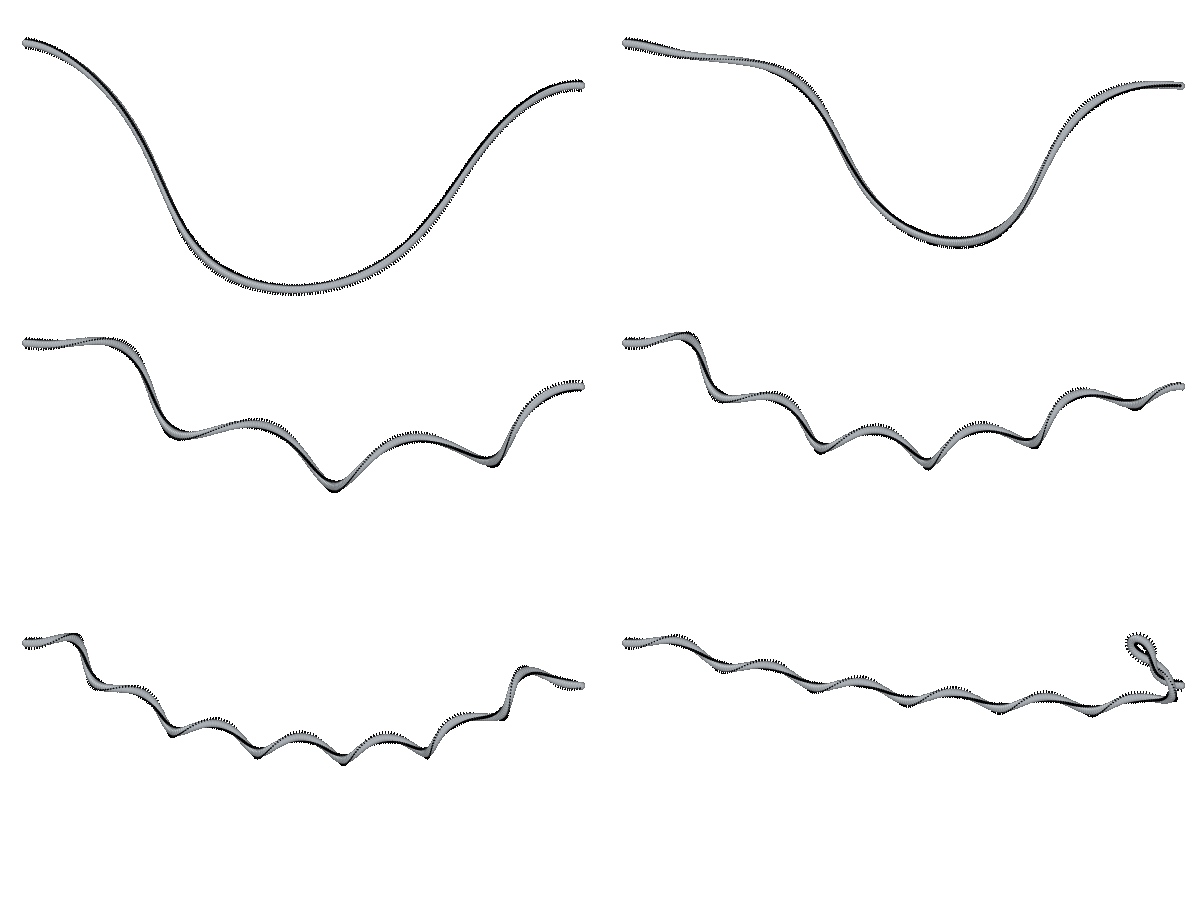
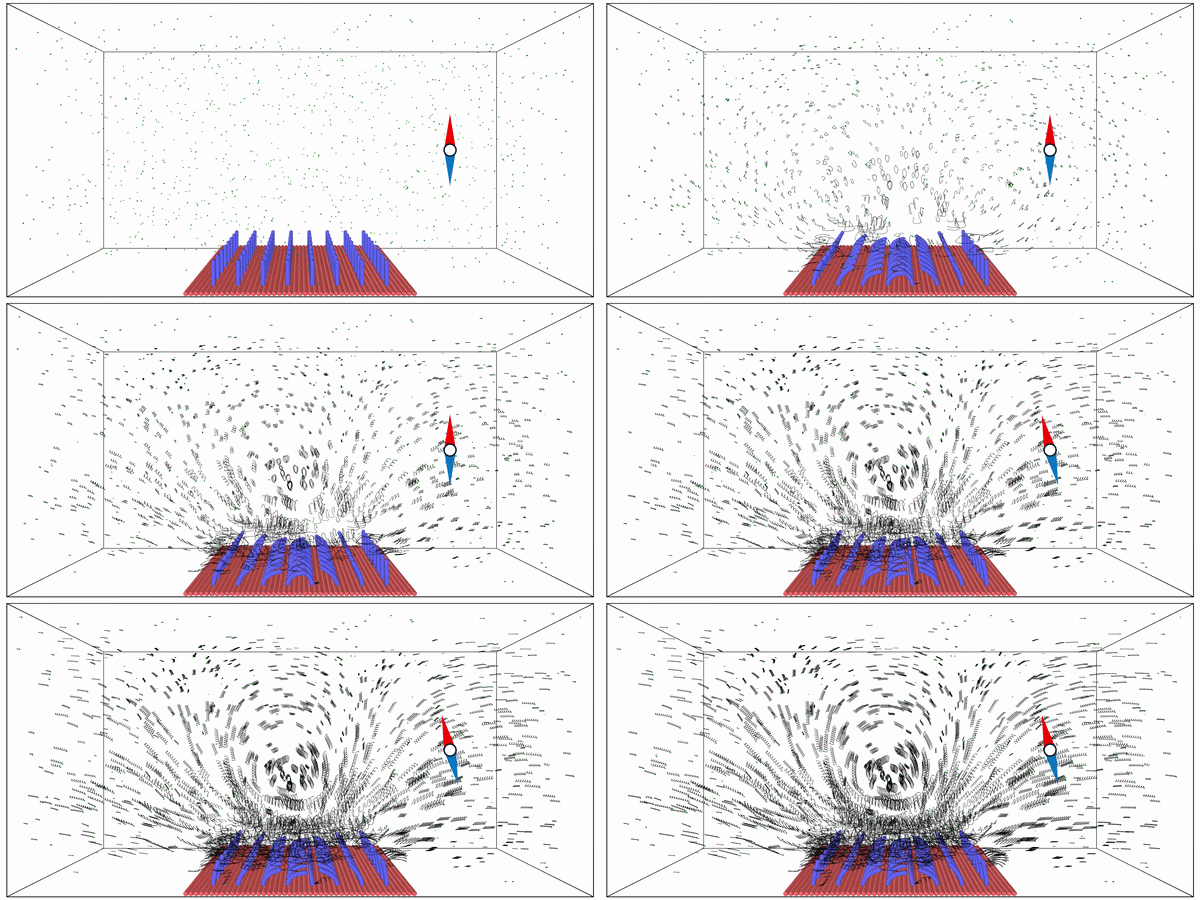
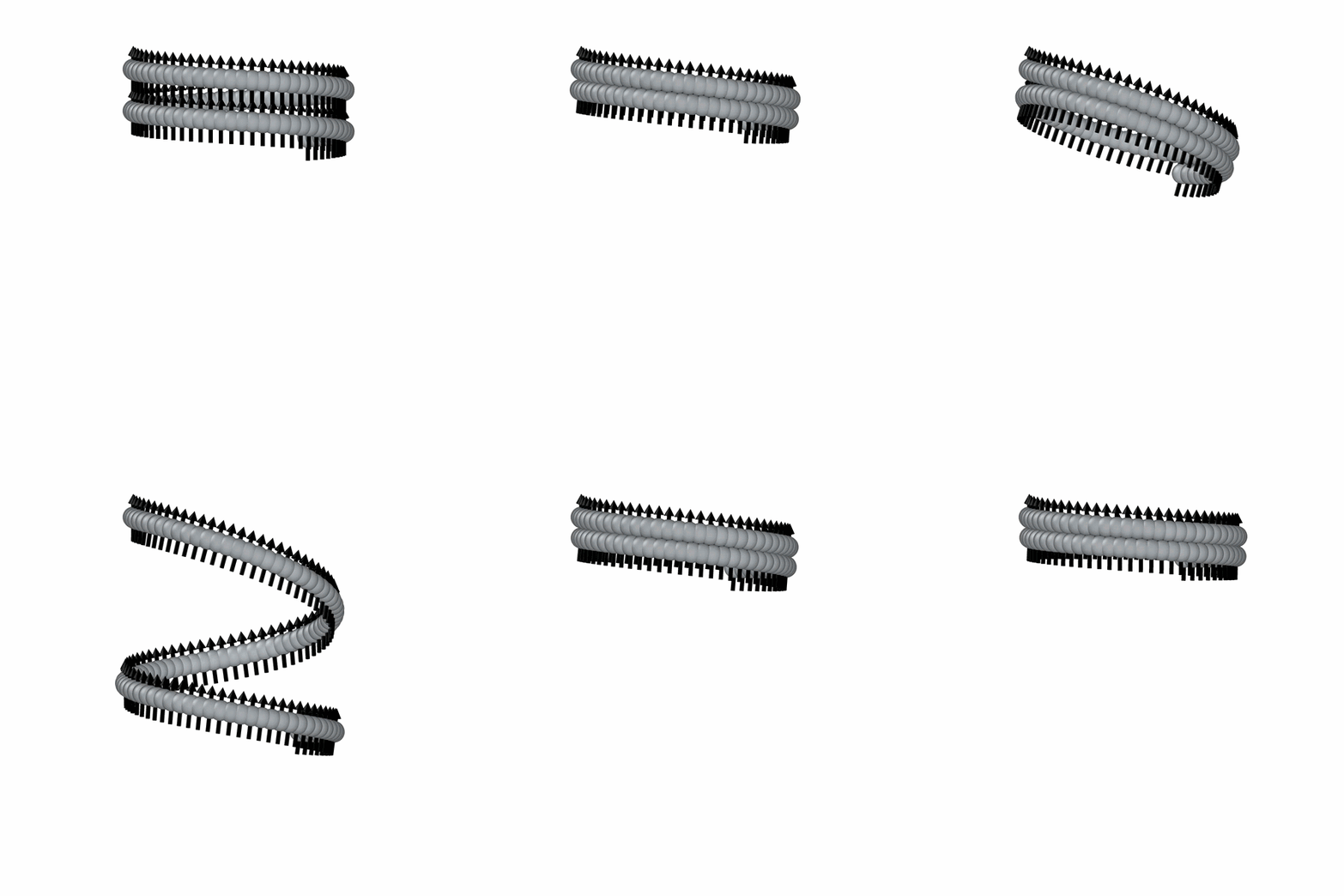
Flexible rods undergoing large deformations are ubiquitous in science and engineering — from biological cilia and magnetic filaments to surgical catheters and soft robots. Simulating these systems requires a framework that naturally handles geometric nonlinearity, contact, and coupling to external fields and fluids. Bonded-particle models (BPMs) treat solids as collections of discrete particles connected by deformable bonds, and fit naturally within the discrete element method (DEM) — a general, scalable framework with modular multiphysics capabilities. Despite this versatility, BPMs remain underutilized for slender elastic rods. Here, we develop a co-rotational BPM formulation for slender rods, implement it in LAMMPS, and demonstrate its broad applicability across mechanics, magnetics, and fluid–structure interaction.
Citation
This page provides additional details and simulation scripts for the examples in:
Alkuino, G., Clemmer, J. T., Santangelo, C. D., & Zhang, T. (2026). Bonded-particle model for magneto-elastic rods. arXiv:2603.27279.
@article{alkuino_bpm_2026,
  author  = {Alkuino, Gabriel and Clemmer, Joel T. and
             Santangelo, Christian D. and Zhang, Teng},
  title   = {Bonded-particle model for magneto-elastic rods},
  journal = {arXiv preprint arXiv:2603.27279},
  year    = {2026}
}
Please also cite LAMMPS if you use the code.
Getting Started
Build Instructions
The model is included in the BPM package as of the LAMMPS 4 July 2026 feature release.
See the bond_style bpm/rotational documentation for details.
To run all the examples on this site, build LAMMPS with these packages:
- BPM — Bonded-particle models
- DIPOLE — Dipole–dipole interactions for magnetic particles
- GRANULAR — Granular pair styles for contact mechanics
- LEPTON — String-expression-based potentials, used by
fix efield/leptonfor non-uniform fields - MOLECULE — Molecule IDs for grouping particles
For fluid–structure interaction examples, the custom CoupLB package is also required.
Usage
The model can be used by invoking the bond style bpm/rotational.
The bond style requires atom_style bpm/sphere
and fix nve/bpm/sphere for time integration.
For magnetic examples, the dipole sub-style must be added via atom_style hybrid.
The update dipole keyword/value pair must be added to fix nve/bpm/sphere to use the magnetic model described in this work.
Note
We use particle and atom interchangeably.
Bonds can be created using create_bonds or defined directly in the data file.
The bond style and coefficients are specified as:
bond_style bpm/rotational <keyword/values>
bond_coeff type Kr Ks Kt Kb Fr_c Fs_c Tt_c Tb_c gr gs gt gb
The optional settings are:
| Keyword | Values | Description | Default |
|---|---|---|---|
frame |
average, particle |
average uses a symmetric central frame; particle uses one particle as reference |
average |
damping |
derivative, dem |
derivative damps strain rates; dem damps relative velocities |
derivative |
break |
yes, no |
Whether bonds can break during a run | yes |
normalize |
yes, no |
Normalizes radial and shear forces by \(r_0\) | no |
smooth |
yes, no |
Smoothly interpolates forces to zero near breaking | yes |
For each bond type, 12 coefficients must be defined, in order:
| Coefficient | Description |
|---|---|
| \(K_r\), \(K_s\), \(K_t\), \(K_b\) | Radial, shear, twist, and bend stiffnesses |
| \(f_{r,c}\), \(f_{s,c}\), \(\tau_{t,c}\), \(\tau_{b,c}\) | Critical forces/torques for bond breaking |
| \(\gamma_r\), \(\gamma_s\), \(\gamma_t\), \(\gamma_b\) | Damping coefficients for each mode |
Note
The method described in the paper uses frame average and damping derivative (both defaults).
All examples use break no and smooth no, with one bond type since each BPM segment is identical.
With break no, the critical force/torque values are ignored.
For more information, see the How to BPM page.
Examples
All examples are self-contained; the simplest is Demo: Cantilever Beams. The remaining examples assume familiarity with the basics covered there.
Miscellaneous
License
Preprint under CC BY 4.0. Source code and simulation scripts under MIT.
This project page was created with AI assistance. All content was reviewed and edited by GA.